
The two energy levels would be the same if it weren’t for factors like sound, thermal, mechanical and friction energy transferred on the way through. The percent energy lost, or transferred, was calculated. Students were to design ways their coasters would minimize the transferred energy. The coasters were to have a footprint no larger than a square meter, be free-standing, have at least two “hills,” the first at least 1 meter high, and be made of readily available resources they could find at home.
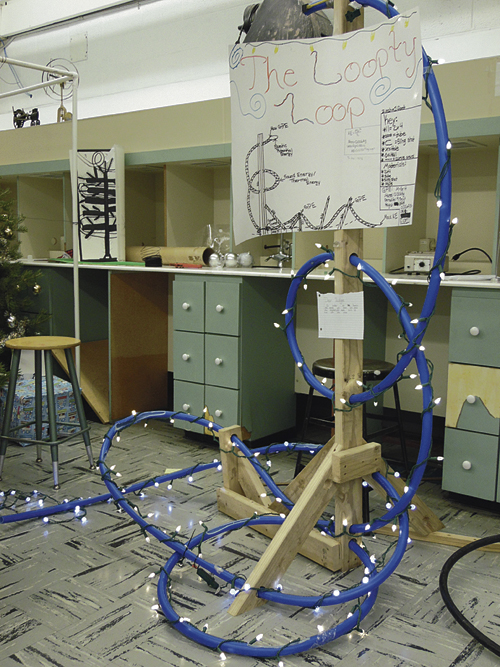
Mrs. Selle called this lesson “Roller Coaster Mania.” The judges’ top 10 results, given here with their percentage of transferred energy, are: No. 1 – The Mega Coaster (20 percent loss), Megan Shelton; No. 2 – The Blue Lagoon Joy Ride (70 percent loss), Kale Burke; No. 3 – The Rat Trap (55 percent loss), Gracie Bradfield and Kassie Luce; No. 4 – The Red Rocket (51 percent loss), Allison Moon; No. 5 – The Tour of Lights (87 percent loss), Luis Villalpando; No. 6 – The Loopty Loop (more than 65 percent loss), Allie Willey; No. 7 – The Anteloop (93 percent loss), Brennan Jensen; No. 8 – The Zipper (33 percent loss), Michaela Jones; No. 9 – The Tower of Terror (4 percent gain), Charlie Day; and No. 10 (tie) – The Dr. Seuss (73 percent), Savanah May and Jonathon Lopez, and The Coaster of Terror, Andy Kracht.
Day’s coaster was the only one that allowed for an energy gain. He let gravity take control the entire ride with his horizontal loops sloping down rather than being completely flat.
According to Selle, Day also used centripetal force in his system.
The judges were Meeker School Board members Bud Ridings, Kevin Amack and Bill deVergie, and former school board member Dan Chinn.
The percent of energy loss was only one of several factors evaluated by the judges.