





Council questions water use, study process
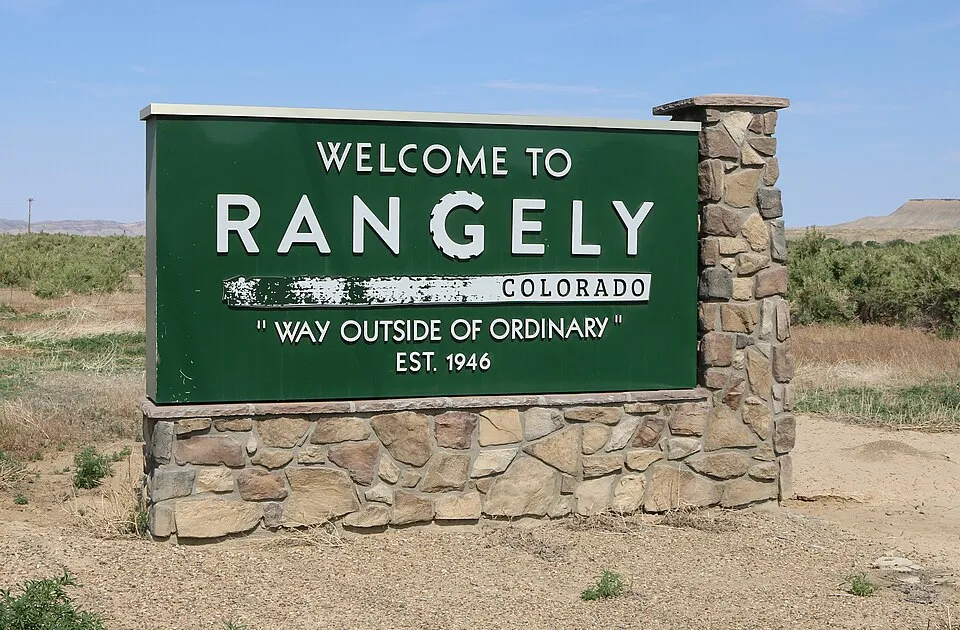
RANGELY | Rangely residents are questioning a proposed geothermal project that includes the use of modular data centers to fund development.
At the Aug. 25 meeting, resident Tanner Nielsen told council he had heard “rumblings” about a potential data center and raised concerns about water use, jobs and what the development would bring back to the community.
Nielsen returned Sept. 8, this time asking the Town to establish greater transparency and specific oversight protocols for any data-center development. He also suggested a moratorium while longer-term ecological, financial and demographic impacts could be studied.
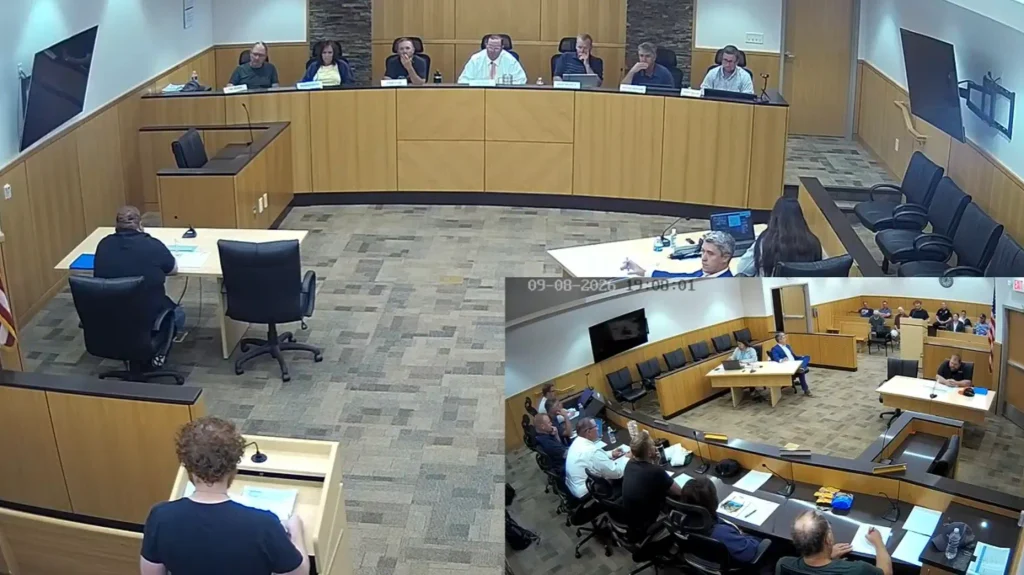
Public comments about the geothermal project echoed some of the questions council members have been asking themselves.
What’s on the table?
The Town of Rangely is exploring a proposed geothermal development that could be funded initially by revenue from “micro data centers.” The model was discussed during the Aug. 11 meeting.
Council members raised questions about water use, whether the same company should conduct phase two of a study, and how much the public understood about what was being proposed.
“Is it a data center?” Thayn asked.
“That’s what we’ve talked about — modular computerized data centers,” Bollinger replied.
Bollinger described temporarily connecting one or two units to the electrical grid and using revenue from the data centers to help fund exploratory drilling, estimating the cost at about $50 million per unit with approximately $17 million in annual net operating income. If the geothermal resource proved viable, the Town could pursue a revenue bond for the larger project. If completed, geothermal energy could used to power the data centers and provide revenue.
Thayn asked why the Town could not simply drill first and find out what was underground before moving forward with additional studies. Bollinger stated, “the issue with that is it’s a million-dollar hole that we have to punch.”
A waterless data center? Not exactly.
“Honestly, we can’t say it’s waterless,” Thayn stated. “The data center is waterless, the geothermal well is not,” he said.
Trustee Tim Webber expressed discomfort with estimates of roughly 10 million gallons to fill each of two geothermal wells — about 20 million gallons initially — along with an estimated 5% to 10% annual loss.
Thayn stated council needed to be straightforward with the public about the model. “In order for this to really generate revenue, it is a data center,” he said. Council members suggested obtaining community feedback via a social media blitz and possible open house.
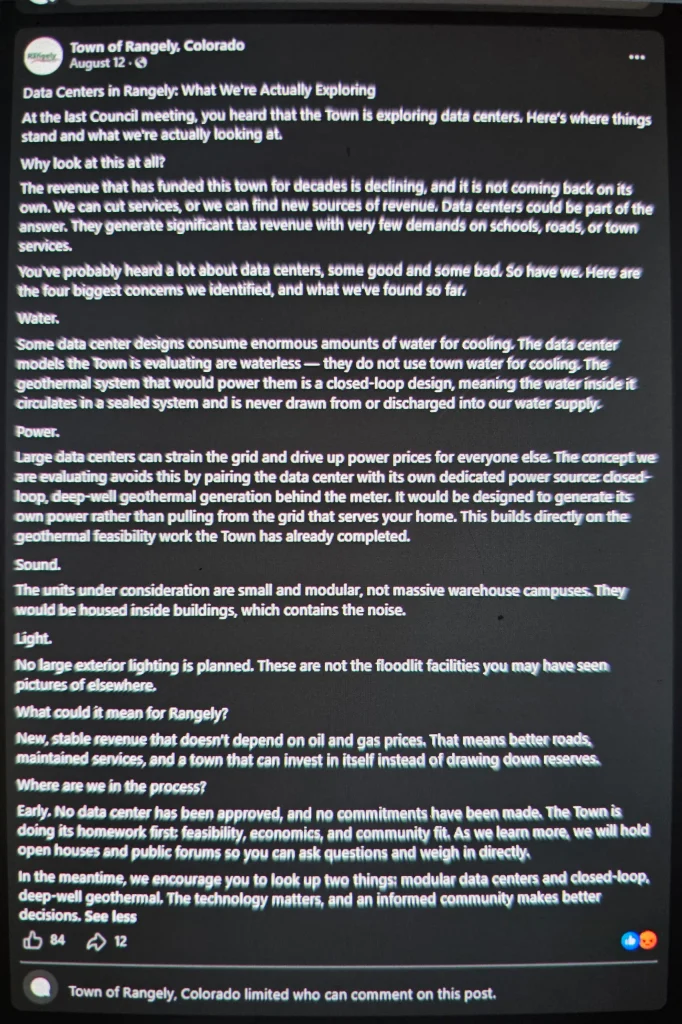
On Aug. 12, the Town published a Facebook post titled “Data Centers in Rangely: What We’re Actually Exploring.” It described the data-center models as waterless and the geothermal system as closed-loop, with water circulating in a sealed system rather than being drawn from or discharged into the Town’s water supply.
Commenting on the post was turned off.
Who’s involved?
Pure-Green Colorado, working with The GreyEdge Group, performed the first phase of the Town’s geothermal work and was proposed to conduct Stage 2 for another $59,850, plus additional costs for legal review. Thayn said he wanted to consider hiring someone who did not have “an 80% stake in the profits,” as early project concepts contemplated an 80/20 equity split.
Bollinger replied the discussion was preliminary, the eventual structure remained unsettled, and his memo to council acknowledged the potential concern. At the Sept. 8 meeting, Bollinger presented an additional option to accepting the Stage 2 proposal: independently obtained quotes for components, at an estimated cost of $93,000 to $280,000 and a timeline of four to eight months.
Pure-Green is involved in a separate proposal in neighboring Moffat County. According to reporting by the Craig Daily Press, Moffat County officials had met with representatives of Pure-Green before an Aug. 5 public meeting, and an April 29 letter from the county referenced Pure-Green’s interest in acquiring the Trapper Mine property for redevelopment involving geothermal energy, advanced computing and an industrial campus.
Publicly-available information about the company is limited. Its website says its technology has been “proven at institutional scale” and references deployments involving a Texas utility, branches of the U.S. military and a Fortune 50 technology company, but does not identify those projects or provide project case studies.
In 2024, Pure-Green was awarded a $297,510 state grant to evaluate geothermal power generation and green hydrogen production at Steamboat Ski Resort. A subsequent Colorado Energy Office presentation states that Pure-Green “had to withdraw from [the] grant award,” although it continued exploring other geothermal opportunities in mountain communities.
Other publicly reported projects associated with Pure-Green include a proposed project for Aspen School District and the aforementioned Trapper Mine. Those remain in the proposal or development stage.
GreyEdge, however, has documented experience with geothermal work. The firm lists Colorado Mesa University’s geo-exchange system in Grand Junction among its projects, and GreyEdge team members describe involvement in development of the campus system. CMU’s system has operated since 2008 and now serves roughly 70% of the campus; the U.S. Department of Energy says it has saved the university about $15.9 million since 2008.
Who is Jonah Bollinger? Outside employment draws questions
Jonah Bollinger became Rangely’s town manager in January. Town Council approved an employment contract running from Jan. 19 through Dec. 31, 2026. Publicly available profiles also identify Bollinger with a private-sector business role.
His current LinkedIn profile identifies the Town of Rangely as his employer, while his profile summary describes him as managing partner at EAI Capital. EAI’s website lists Bollinger among its leadership and describes the company as working with owners of blue-collar businesses to improve operations, increase business value and prepare companies for eventual sale.
That outside employment became a public issue Aug. 25. After speaking to data centers, Nielsen asked council whether Bollinger still worked for EAI Capital. He questioned whether Bollinger’s private business affiliations could create a conflict.
Council did not answer the question at that time. Nielsen was told his concerns had been heard and that Bollinger’s ‘door is open’ if he wanted to speak with him directly
On Sept. 8, resident Jack Richens told the council he was less concerned about “double dipping” than whether another job could interfere with Bollinger’s focus and availability as town manager.
Thayn stated he and Shaffer met with Bollinger and the Town’s attorney and concluded there was no conflict of interest. He stated Bollinger’s outside affiliations, partners or employess had not profited, and would not profit, from the Town’s investments.
Context: Rangely’s water outlook

Rangely has faced numerous water issues this summer, including restrictions, a damaged tank, and an algae bloom in Kenney Reservoir.
The Town declared a water shortage in early June and entered Stage 3 Restrictions Aug. 22. County commissioners subsequently submitted a letter asking upstream users to voluntarily conserve water. Rio Blanco Water Conservancy District made emergency releases from Kenney Reservoir to help maintain water availability at Rangely’s municipal intake. At the Sept. 8 council meeting, Utilities Supervisor Michael Dillon said released water took about 10 hours to travel from the dam to the Town’s intake, longer than officials had anticipated because, he said, the river was “basically empty.”
Thayn said three upstream water rights are senior to Rangely’s, but those alone could potentially “pull the river completely dry.” Officials emphasized cooperation with upstream users and Water Commissioner Betty Kracht helped avoid that scenario.
Meanwhile, the Town’s 1-million-gallon Middle Zone drinking-water tank turned out to be in much worse condition than expected. Inspectors found approximately 82 holes in the floor, the largest about four inches across, along with widespread corrosion. A preliminary estimate put the cost at more than $1 million. The Town is waiting for a full report. Officials are now considering whether it makes more sense to repair the existing tank or replace it. The Town also plans to approach the Colorado Department of Local Affairs about additional grant funding.
As previously reported, a precautionary public-health advisory was also issued this month after visible blue-green algae was identified at Kenney Reservoir.
What about the county moratorium on data centers?
Rio Blanco County adopted a six-month moratorium July 21 prohibiting accepting, reviewing or acting on land-use applications for data center projects located wholly or partially in unincorporated Rio Blanco County.
Bollinger spoke during the county’s hearing in support of the temporary moratorium, but urged commissioners to shorten the proposed six-month pause. He said data centers could provide significant economic benefits but that water, power and environmental impacts should be considered.
The jurisdiction of Rangely’s proposal is less clear. During a May 26 update, Bollinger identified Town-owned property along Highway 139 as one of the potential development sites and said the Town was working to annex the property. An official site has not be determined.

What happens next?
At the Sept. 8 meeting, council tabled a decision on the geothermal and data center project by a vote of 4-2. It returns to the council agenda this Tuesday, Sept. 22.
The Herald reached out to Bollinger for additional comment and records related to the data center project on Saturday, Sept. 19
This story is non-paywalled and free to read.
This is a developing story and will be updated.